


Solar Dictionary
The decision to transition from the noisy and expensive world of petrol generators to the silent, reliable world of solar energy is one of the best financial moves any Nigerian homeowner can make in 2026. However, the moment you walk into a solar shop or browse a website like Greenage Technologies, you are hit with a “wall of solar jargon.”
You see Terms like MPPT, DoD, and Monocrystalline which can make a simple purchase feel like a PhD physics exam. If you don’t understand these terms, you risk doing two things: buying a system that doesn’t meet your needs, or overpaying for features you don’t actually Need.
This comprehensive solar guide is designed to help you Simplify the complex language of solar energy. If you read this article to the end, you will be able to speak “Solar” fluently and make an informed decision for your home.
The Core Components of a Solar powered System (The Hardware)
Before we Talk about the technical specs, let’s define the physical aspects in your solar setup.
Solar Panels (PV Modules)
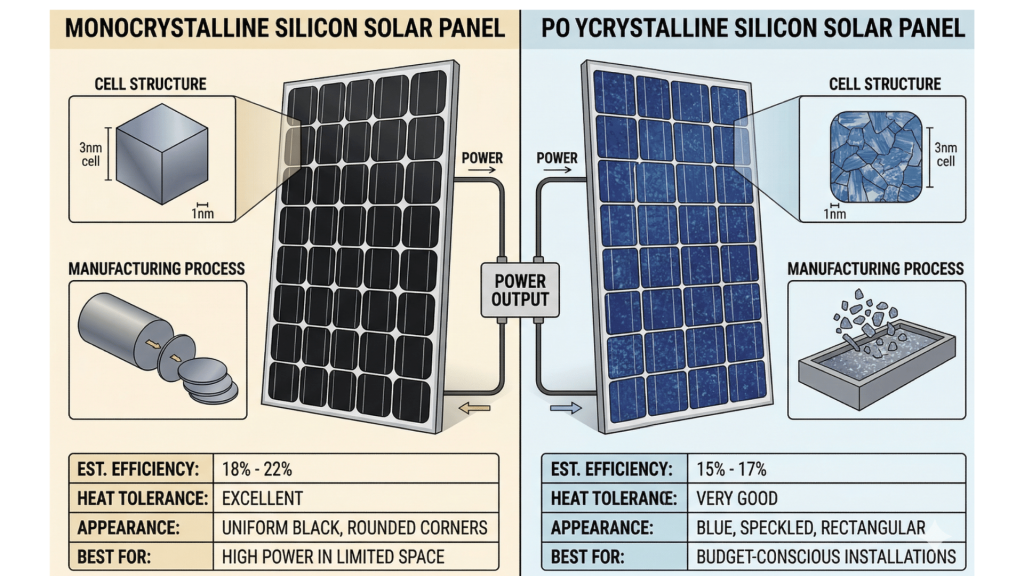
PV stands for Photovoltaic. These are the dark, glass-topped rectangles on your roof. They perform the job of converting sunlight into Direct Current (DC) electricity. They come in two types:
- Monocrystalline: These are the dark black panels. They are more efficient (especially in high heat) and take up less space.
- Polycrystalline: These are blue-tinted. They are slightly less efficient but usually cheaper.
The Inverter
The Inverter is like the “brain” of your system. Solar panels and batteries produce DC power, but your TV, fridge, and fans run on AC (Alternating Current). The inverter “Converts” the current so your appliances can use it.
- Inverter Capacity: Measured in kVA (kilovolt-ampere). This tells you how much total “load” (appliances) you can turn on at the same time.
Solar Charge Controller
This is the “traffic warden” between your panels and your batteries. It ensures the panels don’t “overcharge” the batteries and ruin them.
Battery (Power Bank)
This is your energy storage. Since the sun doesn’t shine at night, your batteries store the energy generated during the day for use when the sun goes down.
Power Measurements Math
This is where most homeowners get confused. Let’s break down the units of measurement.
Watt (W) and Kilowatt (kW)
A Watt is a unit of power. Every appliance has a Watt rating (e.g., a 60W fan).
- 1,000 Watts = 1 Kilowatt (kW).
- If you have ten 100W bulbs, you are using 1kW of power.
Kilowatt-Hour (kWh)
While a Watt is power, a Kilowatt-hour is energy used over time.
- If you run a 1kW heater for exactly one hour, you have consumed 1kWh.
- In Nigeria, “units” on your prepaid meter are measured in kWh.
Ampere (Amps) and Amp-Hours (Ah)
You will see “Ah” written on almost every solar battery (e.g., 200Ah).
- Amps: The speed of the electricity flow.
- Amp-Hour (Ah): The capacity of the battery. A 200Ah battery can theoretically provide 1 Amp for 200 hours, or 10 Amps for 20 hours.
The “Jargon”
Now, let’s tackle the “Big Three” terms that determine the quality and lifespan of your system.
DoD (Depth of Discharge)
This is perhaps the most important term for your wallet. DoD refers to how much of the battery’s energy you have used relative to its total capacity.
- The Golden Rule: You should never drain a battery to 0%.
- Lead-Acid/Gel Batteries: Usually have a recommended DoD of 50%. If you use more than half the energy, the battery dies quickly (in 1-2 years).
- Lithium-Ion (LiFePO4) Batteries: Have a DoD of 80% to 95%. You can use almost all the energy without hurting the battery. This is why Lithium is more expensive upfront but cheaper in the long run.
MPPT vs. PWM (Charge Controllers)
When choosing a charge controller, you’ll see these two acronyms.
- PWM (Pulse Width Modulation): The older, cheaper technology. It’s like a simple on/off switch. It’s less efficient because it wastes some of the power your panels produce.
- MPPT (Maximum Power Point Tracking): The modern, “smart” technology. It’s like an automatic transmission in a car—it constantly adjusts to squeeze every possible drop of energy out of your panels, even on cloudy days. Always choose MPPT for systems above 1kVA.
Pure Sine Wave vs. Modified Sine Wave
This describes the “quality” of the electricity coming out of your inverter.
- Pure Sine Wave: This is identical to (or better than) the power from the national grid. It is safe for all appliances, including sensitive ones like fridges, ACs, and laptops. All Greenage inverters are Pure Sine Wave.
- Modified Sine Wave: A “choppy” version of electricity. It’s cheaper but can cause humming noises in fans, lines on TV screens, and can eventually burn out the motors in your fridge or washing machine.
Efficiency and Environmental Factors
Irradiance
This is a fancy word for “how much sunlight is hitting a specific area.” In Nigeria, our irradiance is very high, which is why solar works so well here. However, dust (Harmattan) reduces irradiance, which is why cleaning panels is Important.
Efficiency Rating
No solar panel converts 100% of sunlight into electricity. Most modern panels have an efficiency of 17% to 22%. A higher efficiency means the panel can produce more power in a smaller physical space.
Temperature Coefficient
Surprisingly, solar panels actually hate extreme heat. As they get hotter, they become less efficient. High-quality panels designed for the Nigerian climate (like those used by Greenage) have a low temperature coefficient, meaning they perform better even when the sun is scorching.
System Sizing and “The Load”
Load Profile
This is a list of everything you want to power and for how long.
- Example: 4 Fans (10 hours) + 1 Fridge (24 hours) + 10 Bulbs (5 hours).
- Knowing your load profile is the first step before a solar company can give you a quote.
Surge Power (Start-up Load)
Some appliances, like fridges, pumping machines, and ACs, need a “burst” of extra energy just to start their motors. This burst can be 3x to 5x their normal running power. Your inverter must have enough Surge Capacity to handle this split-second spike.
Autonomy (Days of Autonomy)
This refers to how many days your system can run if there is zero sun (e.g., three days of heavy rain). For most Nigerian homes, 1 to 1.5 days of autonomy is standard to keep costs reasonable.
Summary Table: The Quick Reference
| Term | What it actually means | Why you should care |
| DoD | How much battery you can safely use. | Higher DoD = more usable power and longer life. |
| MPPT | A “Smart” charge controller. | Gets 30% more power from panels than PWM. |
| Pure Sine Wave | “Clean” electricity. | Protects your expensive electronics from damage. |
| kVA | Inverter size. | Determines how many things you can turn on at once. |
| Ah | Battery capacity. | Determines how long your lights stay on at night. |
Understanding these terms changes you from a “confused customer” into an “informed investor.” Solar isn’t just a purchase; it’s a 10-to-25-year energy plan.
When looking at indigenous brands like Greenage Technologies, you can now see why we emphasize Pure Sine Wave inverters and MPPT technology—it’s because we build systems designed to survive and thrive in the Nigerian environment.
Ready to stop guessing and start generating? Take your “Load Profile” (the list of your appliances) and contact a professional solar engineer today.
Now that you speak the language, you’re ready to take control of your power!
This article was brought to you by Greenage Technologies—Engineering Africa’s Energy Future.
